Exploring the benefits and limitations of rendering geometry
defined by distance functions.
As an undergraduate researcher, I build the C++ application
and controls for a custom SDF rendering engine in OpenGL and
GLSL, working alongside another undergraduate researcher who
writes most of the shaders.
Wrote the quaternion math behind camera rotation, plus the
controls for ray travel distance and surface-hit tolerance.
Pass a scene ID from CPU to GPU to switch between SDF
functions, and added shader hot reload by comparing saved
files against a cached version.
Built in FPS and frame-time counters to help test changes as
we go.
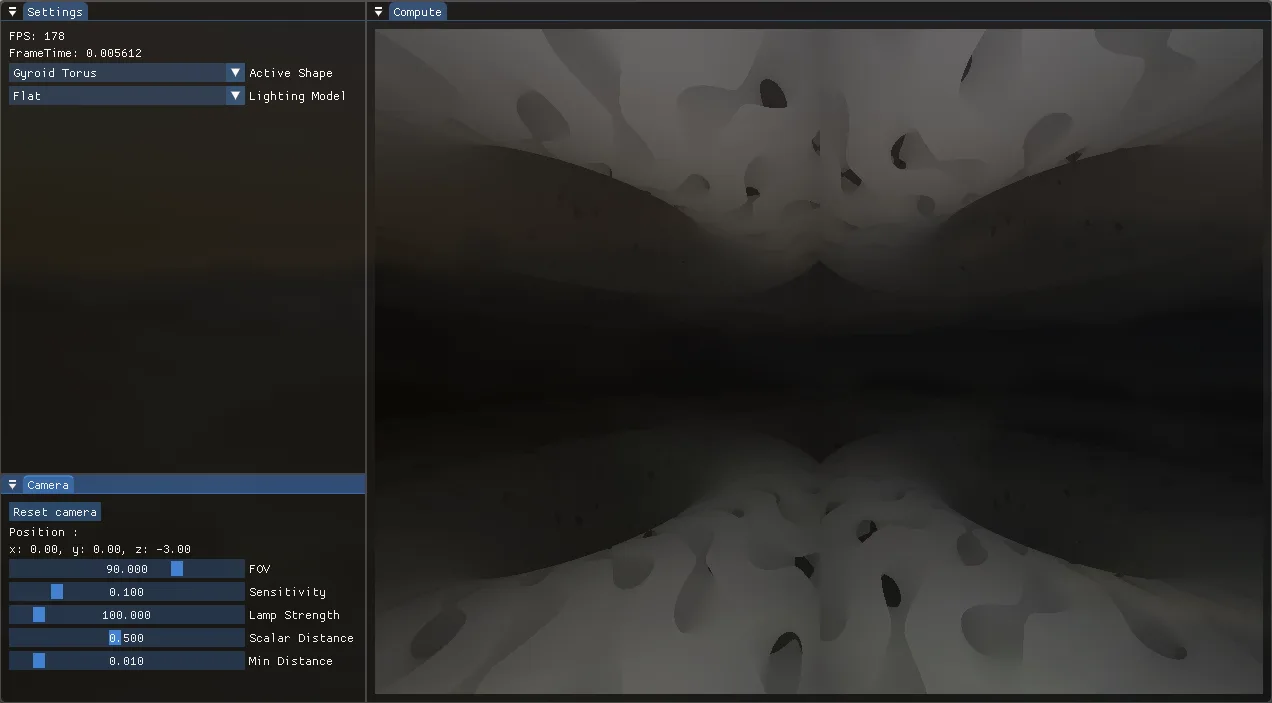
The screenshots show different fractals or infinitely
repeating geometry created through trigonometric functions.
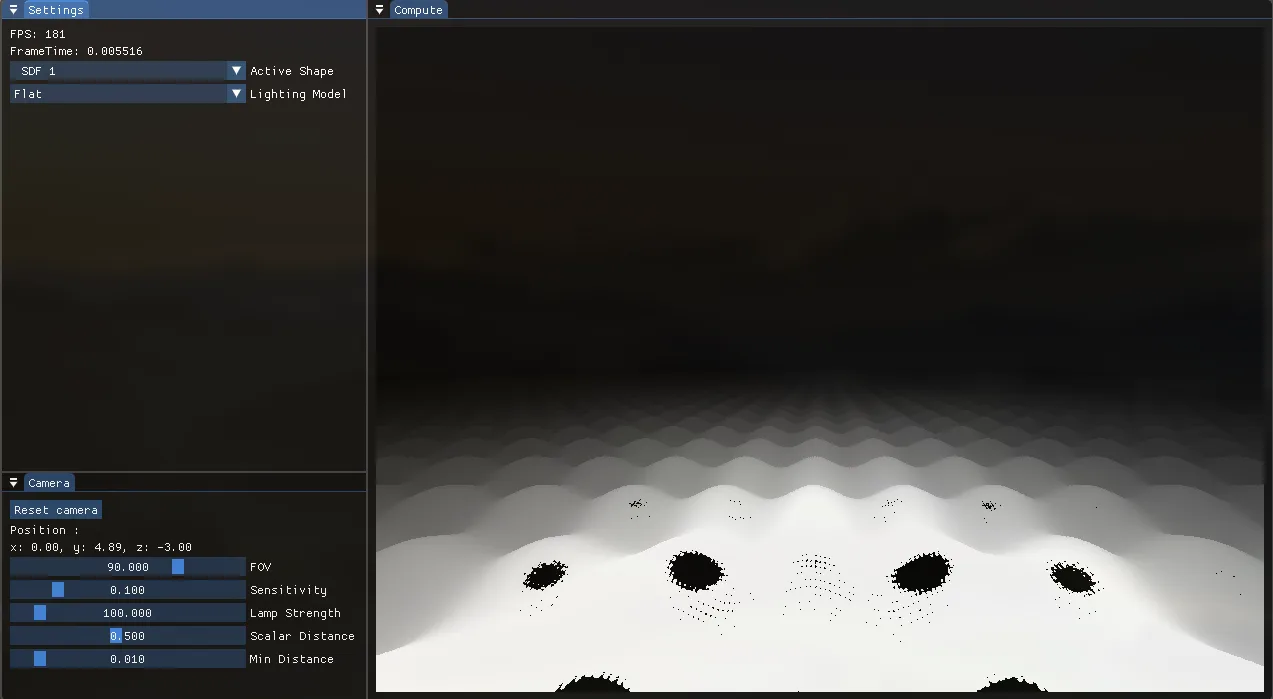
View another render
Repeating-surface experiment. Visible artifacts are part of
the result.
GRAPHICS SOFTWARE
In progress
Blossom
An experimental 3D game engine written in C++ and GLSL using
Vulkan, GLFW, Dear ImGui, and a custom math library. It renders
separate scene and game views with interactive camera and editor
controls.
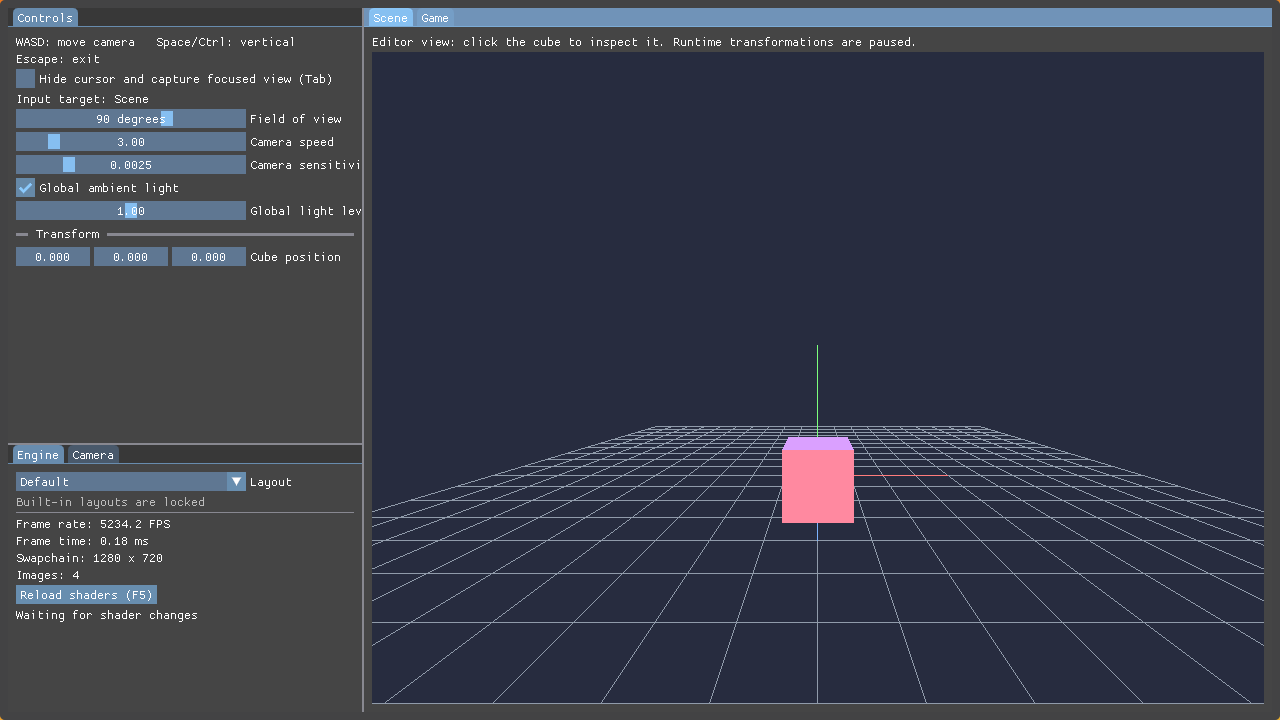
Vulkan scene view with a cube, grid, and editor controls.
Separate scene and game views, with a scene grid and animated
cube.
Camera controls, cube inspection and position editing, and
adjustable ambient lighting.
Shader reloading while the engine is running.
C++ / GLSL / Vulkan / GLFW / Dear ImGui / Custom math
A dependency-free C renderer that rasterizes meshes and
raymarches signed distance fields on the CPU, displaying 3D
scenes in the terminal using Braille characters and ANSI colors.
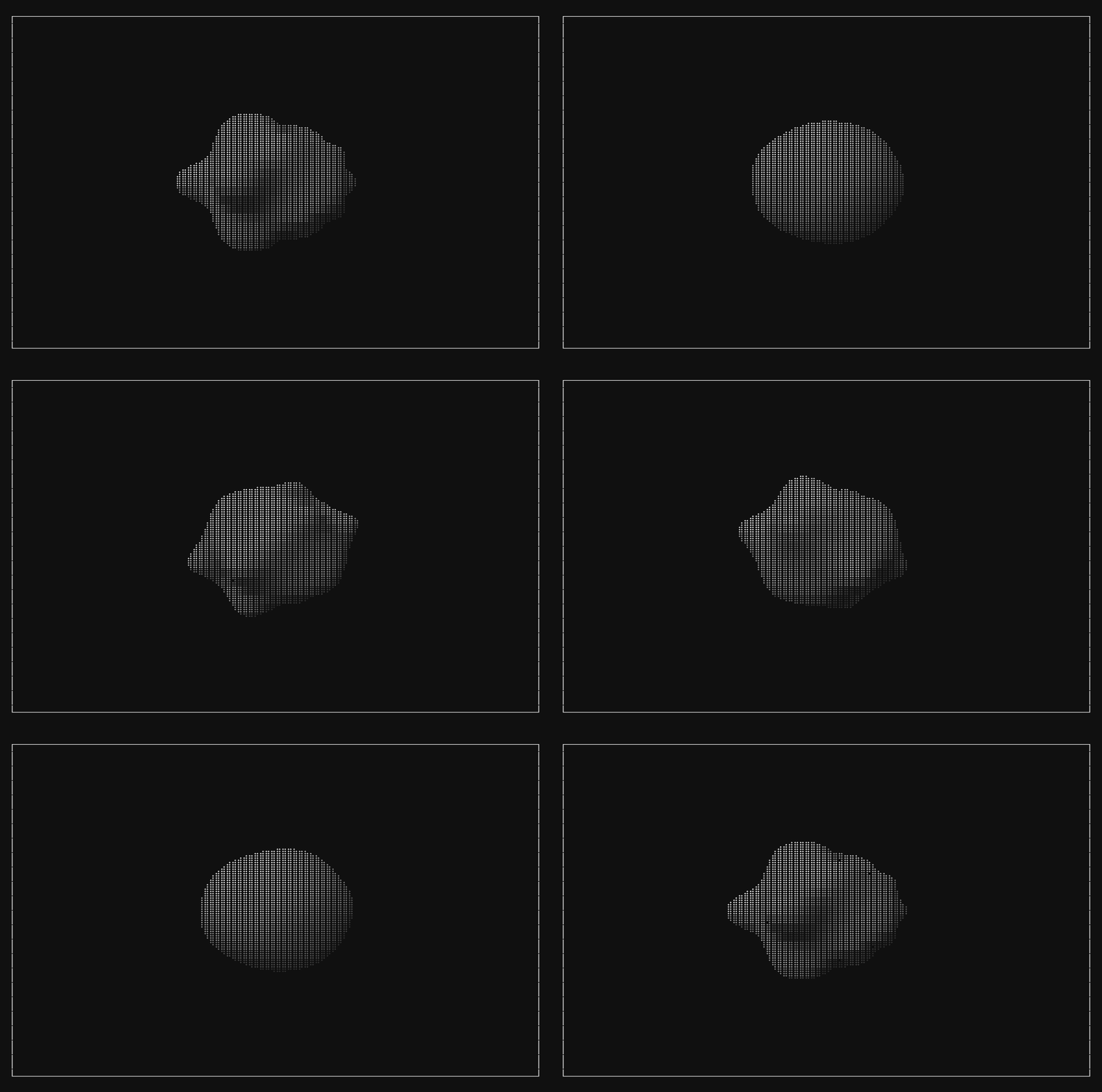
Raymarched sphere SDF with surface displacement.
Builds the terminal UI itself with termios for input and ANSI
escape codes for display and color, no third-party
dependencies.
Supports both mesh rasterization and signed distance field
raymarching on the CPU, with Braille characters for the image
and ANSI escape codes for color.
Wrote a small vector type in C instead of plain arrays, since
a fixed-size array meant passing width and height everywhere
and couldn't support resizing the terminal window intuitively.
McNeese State University · Engineering & Computer Science
Work with another undergraduate researcher and Dr. Lavergne
(McNeese professor) to explore signed distance fields and
figure out ways to make them more efficient.
Current
McNeese Tutor
McNeese State University · Math & Science
Help around five students a week with math through Calculus
II, plus physics and computer science topics when needed.
Current
Church IT
Iowa First Baptist Church
Chose and set up the church’s replacement computer to fit its
needs; continue to support that computer.
When I'm not at my computer learning about programming and
graphics, you'll usually find me playing golf or running around
my hometown.
I've been involved in both sports since I was young and pursued
them competitively throughout high school. I qualified for state
in running and reached regionals in golf, narrowly missing state
by one spot during my senior year.
Background Shader
The shader you see in the background is made in WebGL using
GLSL. I defined a plane and put a displacement of cos(t) +
sin(t) on it to make it into waves. I only take the height
values of this wave and then normalize it. I normalize the
height values and map them to an array of ASCII glyphs,
represented as 5×5 bitmaps. The fragment shader renders these
characters to produce the effect you see in the background. I
track the mouse position to add a smoothstep back to the height
downward to make the animation feel more alive.